A bit about me:
Merry meet! If you’re reading this, chances are you probably have seen my streams or perhaps stumbled upon my small, spiritual based Instagram page. Though, if you searched the web and my blog showed up, this blog may be interesting to you too! I go by Froax, a small town girl in New England who moved to Long Island in hopes of rebuilding my life. Trauma and pain changed me, but I turned that pain into something beauitufl, something a bit more comfortable. If I was to describe myself a year ago to an audience of complete strangers during a live broadcast, I would only say two words, “content creator” and “dog mom”. I used to dread what people may think when speaking upon Wicca. The fear of hearing “devil worshiper” and “psycho” or perhaps even “stupid girl” held me back. But Wicca really isn’t any of those things. Why was I so nervous about the thoughts of negative, closed-minded people?
Something had to be done if I wanted any type of change!
With the support of my ever-growing community, I realized they were no longer strangers. They were open minded, kind, and caring. It was time I stop letting fear hold me back and time for me to be more honest with both them, and myself. They of all people deserve to get to know me on a more personal level.
Following my chosen path:
Today, I would describe myself as a hereditary intuitive clairsentient empathic Wiccan who’s focusing on herbal apothecary while aiding in the art of nature and tarot. I often say that I’m into candle magick and describe myself as a solitary practitioner to keep conversations with outsiders short as most people are usually quick to assume that I’m a small business selling and making candles. Though, I’m not that crafty and not educated on how to make candles to begin with. Talking to people and connecting with others is my true talent.
Things got easier!
It gradually became easier to talk about and I felt more comfortable being open this past year. I enjoy studying the evolution of Pre-Christian traditional vectors alongside historic symbolism such as Runes, elemental sigils and what they represent, along with the astrological and numerological connection and appeal of modern day magick.
New perspectives:
I owe it to my community, friends, and family to be transparent. Who knows, I may end up inspiring someone along the way! If more people started speaking out, honoring and embracing their spirituality, I believe it may help educate those curious, and further normalize our historic tradition.
A kind introductory:
The responses I received were overwhelmingly nice, despite the occasional insults. I have realized that these insults were not due to blunt judgment, but more so those who spoke out of fear due to being uneducated and misinformed on Wicca. Due to this, I did my best to share my knowledge on Wicca through what I have learned.
A little piece of history:
The rise of the Neopagan religion of Wicca can be traced back to the Twentieth Century with a founder by the name of Gerald Gardner, who often incorporated parts of Paganism into his practice of Witchcraft. Today, Wiccan beliefs are popularized more than ever! With practitioners and curious friends, people continue to study and research more of it’s qualities and traditions thanks to modern day technology and the access of resources we all have available to us.
Where did Wicca stem from?
Wicca, a spiritual-focused religion was derived through Paganism. Without diving deep into the history of Wiccan beliefs and practices, Wicca is basically a sub category of Paganism. Think of Paganism as an umbrella, and Wicca is just one of the many raindrops dripping off of that umbrella. Various religions have evolved in which originated from Paganism. Each pulling their own bit of history while evolving it to their own liking. Pagan’s believed in multiple Gods and Goddesses, spirits and elements carrying on questionable yet fascinating traditions. Although zodiac based religions derived from Taoism, Pagans also believed that the planets had magical powers connecting our energy with the galaxy. Paganism is our oldest and oddly enough, newest religion, due to being the most evolved. Modern Paganism is one of America’s fastest-growing religions with an estimate of 1 million supporters and growing daily.
What is Wicca?
In Wicca, we often believe in the worship of various Gods and Goddesses or none at all. We believe in the worship of nature and manifestation through energy while using various methods such as rituals to transform and boost that energy. That’s where magick in Wicca comes from, that energy is what it is referring to.
What is the difference between a Wiccan and a Pagan?
Wiccans follow a nature-oriented religion incorporated through rituals and practices which are derived from Pre-Christian religious beliefs due to Paganism. Wicca has a bit more structure when it comes to ceremonial rituals and spells. Pagans are a religious, spiritual, or cultural community based on the worship of nature and the earth. In Paganism, Mother Earth is often emphasized as the Goddess and one of the main focus points. Paganism is a bit more free-flowing when it comes to ceremonies, rituals, and whether or not they work with magick. Whether you are Wiccan, Pagan, or actively follow both, it’s important to keep in mind that both share similar history, values, and traditions.
Traditional vs. Modern Wicca:
In traditional Wicca, Wiccans believed in the High Priestess and High Priest. Generally, structured witchcraft is often associated within Wicca along with covens, often mistaken as cults. Covens were referred to as a sacred place, no outsiders were ever welcomed in. Practicing in front of outsiders was a life or death risk and frowned upon. Not only was it once viewed as disrespectful to practice alone, but it was also incredibly dangerous given it’s tragic history when it comes to witches and those of inner power. Covens would usually require an initiation process before being accepted into the coven, and being a part of a coven was viewed as more acceptable and legit in comparison to solitary practitioners. It was thought that those who participated in this practice together created stronger power. It wasn’t uncommon to view those within solitary practice as weak. Traditional Wicca was much more exclusive and strict, and only those who were viewed as worthy were accepted into the inner circle.
With modern Wicca, most Wiccans believe in various Gods and Goddesses including Mother Earth, or none at all. Covens and virtual covens exist today, some of which do not refer to themselves as being a part of a coven, but rather a group of people or friends. It’s common to often see ceremonies outdoors in somewhat-public areas. Ceremonies can be seen in somebody’s yard by someone driving by or simply walking their dog, all without fear. Most of these groups and virtual covens that are around today are inclusive to all, offer no requirements or limitations, no initiation process, and can be found helping out others in various ways. Although Wicca has it’s own similar structure, there is no right or wrong way of invoking or releasing energy. Covens are no longer viewed as a requirement, and solitary practitioners are viewed just as valid as those within a coven or any other type of group. Modern Wicca is much more normalized and inviting.
Similar to modern day Christianity, you do not have to go to church every Sunday in order to be considered a devoted Christian. Though, I am sure many might suggest otherwise and recommend Sunday Service. With Wicca, you do not need a cauldron or an alter, especially resembling the expensive ones you see in mainstream movies and witch-based television shows. It can be as simple as your own vanity or dresser if you wish, maybe even a chair of some sort. As said, some might suggest otherwise and may recommend an alter separately to represent the main focus point of your practice. Personally, I think telling others what is and isn’t acceptable within one’s own spiritual journey of any sort, is limiting and has a fine line between being genuine and over stepping boundaries. This is their journey. As long as it is not causing harm, let people experience their spirituality however they feel comfortable. Modern religion of all types are continuously evolving just as our minds are continuously learning.
What does that little circle and star symbol mean?
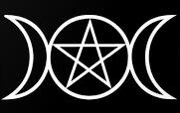
There are many historic symbols within Wicca. Some are original and widely known and some have evolved with time. In this case, the five-pointed upright star within a circle is known as a pentacle and represents balance, harmony, intellect, and good intent, with each point of the star signifying the five elements; spirit, water, fire, earth, and air. (Not to be confused with the pentagram), Pentacles that are displayed in comforting areas on surfaces or displays have been known to boost energy, increase one’s psychic ability, and is thought of an act of honoring the ancestors before us bound by either biological relation or by spirit. The Pentacle with the two moons is known as a Triple Moon Symbol which is a symbol used to represent the Triple Goddess. The Triple Moon was also designed to showcase the different moon cycles and is extremely popular amongst Pagan and Wiccan communities.
Wicca wasn’t always good, but it wasn’t all bad either! It was different for all..
A lot has evolved with witchcraft in modern day compared to old western world traditional values and practice. We truly are good people! There’s so many types of practices when it comes to Wicca, such as tarot and cartomancy, moonology, oneiromancy, and even herbal apothecary, along with various other curious, precious practices. Tarot doesn’t always have to be about reading into ones future, but can also be used for self guidance, healing, and daily advice for ones self and loved ones. Things such as necromancy, is also a study within Wicca and other religious vectors around the world. Not every Wiccan engages in each and every practice offered, and we do, it’s often out of pure intention and to cause help rather than harm. It’s all about preference and what calls to you the most. Some being more sensitive at a specific practice than others. Focus on finding your niche that you’re educated on and enjoy by being mentally and physically subjective to the energy around you, as one would say.
Banishing fearful emotions and decline judgment onto others!
People get scared and hesitant to engage in conversations with topics they don’t understand. Fear comes from being unfamiliar with topics or situations either due to lack of knowledge or negative past experiences. Fear is acceptable and should be normalized, but so should stepping out of your comfort zone when it comes to respecting those around you. I don’t judge those who disagree with my spirituality, but I do expect people to respect mine just as I respect there’s. There are more than one religion out there, and all should be accepted and respected equally as long as no physical harm is being done. Another reason why people often get nervous when speaking upon Wicca is due to confusion with the devil and evil. Truthfully, Paganism with the subcategory of Wiccan belief is a traditional Pre-Christian religion, long before God and Devil. Good vs. evil is present in every religion in their own way.
An example of evolutionary magick:
With Wicca, good magick goes well with nature and pure intention, where as the bad aspect goes against nature and offers negative intention. The majority of us are good. We believe that the energy we put out we will receive nine times back, so practice magick to cause harm onto others both mentally or physically would ultimately harm us in the end and much worse. Some even declining to practice traditional love spells due to the lack of consent and interfering with someone else’s preference and goodwill. Instead, we have substitutes for this by having the intended partner placing a rose under their pillow as a form of consent.
Why do you say magick instead of magic?
The spelling is derived from early modern English. Originally seen as early as 1651 English translation of the medieval occultist Heinrich Cornelius Agrippa’s Of Occult Philosophy. An English occultist that grew in popularity during the 20th century by the name of Aleister Crowley, has been known to first popularize this variation of spelling. He wished to separate witchcraft from traditional magic tricks that you’d often see at performances done by magicians. Today, occultists and metaphysical practitioners started to come up with own definitions of magick while all falling under the same commercialized category.
There really is no difference in what a Wiccan is referring to when we say magick or magic. However, similar to Aleister, most of us prefer using the term magick to signify spirituality in comparison to a magician with neat tricks. It’s easier for others to identify our meaning behind our conversations by determining and understanding which type of magick we are referring to. Either are acceptable, and we mainly use this terminology for others rather than ourselves. The standard definition of modern day magick means, “In Wicca and certain other belief systems, action or effort undertaken to effect personal transformation or external change.“
My Concluding Thoughts:
There is no shame in your belief or spirituality no matter how weird or mythical it may come across to others. Learn to embrace your spirituality and accept those with beliefs who do not align with your own. Embrace your curiosity and share wisdom without disrespecting others. Never press your views onto someone, but rather encourage questions and knowledge. The next time you are curious on something, just ask! Always ask don’t assume, be kind or simply don’t engage in the conversation, and educate using free resources online or knowledgeable modern books before providing informative statements to others. I’m grateful to be able to embrace this beautiful gift and very excited to share this virtual journey with you. Thank you for allowing me to share my knowledge with curious friends.
– Blessed be!
 froax®